Organizational Culture

Assessment, audit, and management of organizational culture

We help you create a cohesive corporate identity that strengthens pride of belonging and team spirit, align it with your strategic objectives, and foster a culture of excellence that gives you a competitive advantage in the market.

Request information
Cultura organitzacional Cohesive corporate identity Openmet 4C model Strategic consultancy

Hundreds of companies trust Openmet

Objectives of an organizational culture study

An organizational culture study helps you:


  • Understand the values, beliefs, policies, and norms that govern the corporate identity, and identify the attitudes and behaviors that characterize it.
  • Assess whether the current culture is effective in achieving the vision, mission, and strategic objectives.
  • Detect cultural barriers and the gap between the current and desired culture.
  • Discover opportunities to drive innovation and creativity.
  • Provide information to leaders and employees for decision-making and to encourage participation and engagement.
  • Implement a new culture that leads to excellence.

Benefits

Your culture is your competitive advantage

A strong culture attracts talent, speeds up decisions, and supports sustainable business growth.

Greater engagement and satisfaction

Increase the team’s engagement, motivation, and job satisfaction.

Talent retention and attraction

Reduce turnover and strengthen the ability to retain and attract talent.

More agile decisions and communication

Improve and simplify decision-making and strengthen internal communication.

Innovation and adaptability to change

Foster adaptability to change, innovation, and creativity.

Brand and customer service

Strengthen brand image and identity, and raise the quality of customer service.

Higher profitability

Directly impacts the organization’s financial profitability.

Openmet 4C model

A proprietary model to improve your culture

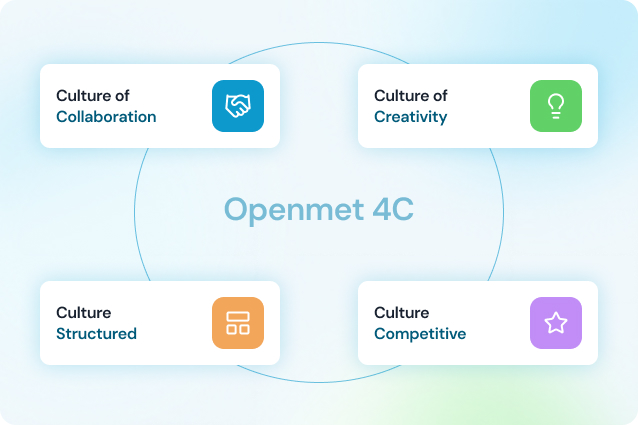
Openmet 4C is our reference framework that identifies four types of organizational culture to understand where you are and where you want to go:

  • Collaboration culture: teamwork, people development, and trust.
  • Creativity culture: innovation, risk-taking, and continuous change.
  • Structured culture: stability, efficiency, and proper production scheduling.
  • Competitive culture: results orientation, market penetration, and positioning as the best in the market.

YOUR PARTNER

Why Openmet?
You need a partner, not just software

20+ years of real-world experience

Over two decades transforming the organizational culture of companies across every sector.

500+ companies vouch for us

The trust of hundreds of clients certifies the strength and reliability of our methodology.

Proprietary technology

Exclusive Business Intelligence software to analyze results and make data-driven decisions.

Expert guidance

More than a platform. We're a human resources consultancy specialized in organizational culture that helps you execute and measure every improvement.

AI-augmented consultancy

More time with you, less spent on document production. We let artificial intelligence work in the background so we can focus where we add value.

Start improving your company's organizational culture today.


    FAQS

    What is organizational culture?

    Organizational culture is the set of values and beliefs that the people in an organization share. It shapes the corporate identity and provides the patterns of thought, expectations, frameworks for action, feelings, and reactions that guide decision-making, organizational processes, and other activities. Successful organizations have strong cultures that attract, retain, and reward people for their roles and the achievement of objectives.

    Why is organizational culture important?

    One of senior management’s most important roles is to shape the company’s culture and identity, which has a significant impact on the organization’s medium- and long-term development. Today, culture is considered one of organizations’ most important assets and forms the central core of their intellectual capital. It’s no longer perceived as a variable, but as a constituent dimension of the organization.

    BLOG

    Latest articles

    News, tools, techniques, and advice on organizational culture

    work environment

    Commitment: Points to analyze in a work environment survey

    This article attempts to show the keys to OpenMet’s work environment model based on EFQM. In the 5F model, “The 5 factors for assessing human and organizational potential”, the first factor is Commitment. Commitment is composed of three major indicators that orient the keys to this factor. These are: Strategy and culture, Engagement and Loyalty. 1. Strategy and culture. This indicator will help us to understand the Strategy on the one hand: whether our employees are aware of the company’s goals, their role in the company, whether they sense that the organization trusts its people and the vision of future prospects. This is critical to understanding whether “we are all headed in the same direction.” Culture is analyzed through Management’s orientation to recognition, alignment with the goals of the latter and knowledge of and adherence to the values ​​and culture of the company. 2. Engagement. This is the second indicator of the Commitment factor. Engagement concerns direct vision, the work itself, and – indirectly – the organization. Awareness of the objectives and their clarity and willingness to work over and above what is expected are the items that best represent this direct vision. The pride of belonging to the company and even the department are key for organizational engagement. 3. Loyalty. In this indicator, several general items are analyzed that we can consider key and as having the greatest influence on commitment. On the one hand, the perception of being a good place to work and contentment with the work done as an employee and, on the other, the recommendation to others as a good place to work and repetition in the choice of current company. In summary, Commitment in the 5F work environment model relates to strategic aspects of the company, the future vision of the company, the alignment with values ​​and culture, engagement with one’s own work and with the organization, loyalty to the organization, recommending to others, pride in what is done and the general perception of the company as being a good place to work. More information on Work Environment. […]Read More… from Organizational Culture

    Delegation

    Delegation, not instruction: Concept and evaluation

    Delegation is one of the necessary skills of any Leader. Good delegation is far more than the transfer of tasks and functions. To delegate properly, we need to analyze the skills, personality and experience of the people to whom we want to delegate a task. Being a good leader means being knowledgeable of the qualities and skills of team members. The person assigning the responsibilities also needs to clearly explain what they expect and provide the tools, support and funds needed to carry out the task. It is very important that the person delegating the task grants autonomy and decision-making capacity to the other person, trusting in their abilities while offering help and support when the situation so requires. Only leaders who meet these requirements will be able to retain and attract the best talent for the organization, improving the work environment and increasing business productivity and profits. To analyze the index of delegation in a company, we need measuring tools and subsequent support. There are two basic measuring tools to determine this index: Work Environment Study and Competency-based Assessment. The Work Environment will tell us how much the leaders delegate in the opinion of different reference groups. Work Environment also gives an insight into the perception of general leadership, commitment, talent management, organizational efficiency and assessment of hygiene factors Competency-based Assessment can be useful in two ways: to define the desired competencies and to find out the their development index. This is a more personal type of assessment where, besides analyzing the delegation skills of the leader, we can analyze the response of different team members to the delegation. An effective assessment allows us to correct delegation behaviors through the opinions of others and self-criticism. […]Read More… from Organizational Culture

    Liderazgo

    Leadership: Points to analyze in a Work Climate project

    This article attempts to show the keys to Openmet’s work environment model based on EFQM. The second factor in the 5F model, “5 factors for assessing human and organizational potential”, is Leadership. This factor belongs to the Motivators group (Commitment, Leadership and Talent Management). Leadership. Work environment survey Leadership has four major indicators guiding us to the keys of this factor. They are: People management, Empowerment, Recognition and Feedback. The leadership evaluated is direct. 1.People management This indicator relates to the direct management of work teams and the role of the leader. The key competencies in direct team management are setting clear guidelines, active listening to ideas, conflict resolution, coordination, accessibility, clear and honest communication and team motivation. 2. Empowerment The delegation of responsibilities, the team’s knowledge of its goals and responsibilities, the leader’s ability to get the most out of their team members and the confidence they exude are the keys to effective team delegation. 3. Recognition Making sure that the team feels acknowledged is one of the hardest things for a leader to achieve. By assessing the level of recognition and comparing positive and negative feedback, we can reflect on these aspects of team management 4. Feedback Another of the most critical indicators in leadership is feedback. Clear and direct feedback, performance reviews and objective evaluation criteria are the key aspects of this indicator In summary, Leadership in the 5F work environment model, centers on aspects of direct people management. Good leader communication, coordination, accessibility, conflict management, team coordination, clear and correct delegation, recognition and constant and objective feedback are the keys to leadership assessment in our model. More information on Work Environment. […]Read More… from Organizational Culture